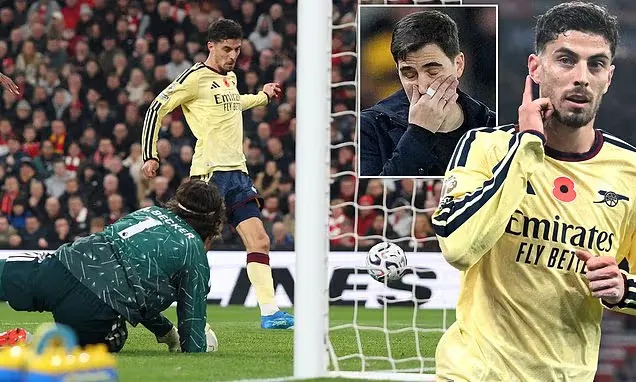
Arsenal won at Anfield for the first time in 14 years as Kai Havertz’s early goal secured a 1-0 victory over Liverpool, offering Mikel Arteta an emphatic response to their League Cup elimination by Fleetwood Town five nights earlier.
The result lifted Arsenal above Manchester City to the Premier League summit. It also changed the immediate discussion around Arteta: a manager facing scrutiny after defeat by a side sitting 18th in League Two had overseen a victory at a ground where Arsenal had not won since 2012.
Both reports connect the two results, with Arteta crediting the Fleetwood disappointment as motivation. Yet the stronger conclusion concerns what Arsenal did with that frustration. Their response was not an uncontrolled attempt to prove their attacking quality, but a performance built around taking an opportunity and protecting the advantage.
Rice gives Arsenal their decisive advantage
The winning goal arrived after 16 minutes and began with Liverpool surrendering possession while attempting to play out from a goal kick. Noni Madueke found Declan Rice advancing outside him on the right, and Rice delivered the ball for Havertz to finish at the far post.
It was a revealing sequence because Rice supplied something beyond midfield security. His movement gave Madueke another passing option and forced Liverpool to deal with a runner approaching from a different angle. The eventual finish was straightforward; creating that simplicity required coordinated movement.
Rice’s importance was apparent again almost immediately. Arsenal encountered trouble in their own build-up, allowing Bradley Barcola a route towards David Raya, but a poor first touch gave Rice time to intervene.
Those incidents complicate any account that reduces the match to Liverpool making a mistake and Arsenal avoiding them. Both sides exposed themselves near their own goal. The difference was that Arsenal punished Liverpool’s error, then recovered from their own. Execution at either end, rather than a wholly different appetite for risk, separated them.
Liverpool’s pressure needs a closer reading
Liverpool finished without a shot on target, a striking outcome for a home side that spent substantial periods attacking. But that figure alone would give an incomplete impression of Arsenal’s defensive performance.
Florian Wirtz struck the crossbar with a free kick, while Alexis Mac Allister headed over from a promising position before half-time. Liverpool also had penalty appeals rejected, including one involving Jurrien Timber pulling Alexander Isak’s shirt.
The detailed match report questions that decision. There is not enough supplied evidence to settle the refereeing debate, but the incident belongs in an assessment of the contest. Arsenal’s clean sheet combined strong defending with moments when Liverpool might reasonably have expected more.
The distinction between the halves matters, too. Liverpool generated threatening situations before the interval, but found clear openings harder to produce afterwards. Arsenal’s achievement was therefore not that they eliminated danger throughout; it was that they became increasingly effective at restricting it while defending a narrow lead.
Liverpool’s frustration grew as their possession failed to yield an equaliser. Meanwhile, Arsenal retained enough attacking threat to prevent the match becoming entirely one-directional. Alisson’s one-handed stop from Christos Tzolis was a reminder that the visitors could still extend their lead.
Vindication, but not a verdict on everything
The victory strengthens Arteta’s position after an uncomfortable week. It does not, however, automatically resolve every argument arising from Fleetwood, particularly the debate about his response to Max Dowman’s dismissal.
The fuller report strongly defends Arteta’s handling of the teenager; the shorter account concentrates on the manager’s belief that the cup defeat helped inspire the Anfield performance. Those emphases are compatible, but they establish different things. A successful team response is evidence of resilience, not independent proof that every individual interaction was handled correctly.
Nor does the contrast between the results explain exactly what changed. The supplied reporting does not establish how far selection, preparation or conversations within the squad contributed. Arteta’s explanation gives insight into his interpretation, rather than a complete account of the turnaround.
What can be judged is the football. Arsenal survived an unsettled opening, converted a well-constructed attack and made Liverpool’s pursuit increasingly difficult. Their established organisation held up under pressure without removing their ability to threaten at the other end.
Calling them a completed side would go further than one match can support, especially so soon after Fleetwood. But this was persuasive evidence of a team capable of absorbing embarrassment without allowing it to dictate the next performance. At Anfield, Arsenal did not erase their cup failure; they demonstrated that it need not define them.