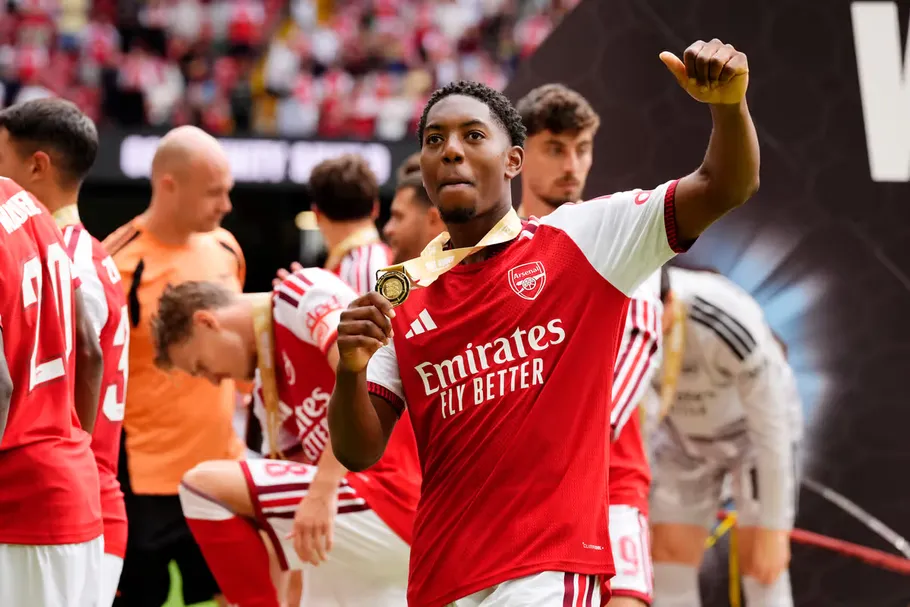
Arsenal have indicated that they want to keep Myles Lewis-Skelly despite growing discussion of a possible Manchester United move, while the player is reported to be focused on staying in north London.
The 19-year-old has become the subject of renewed transfer scrutiny after Wayne Rooney argued that United should pursue him if an opportunity emerges. Reporting around the situation has included a suggested £45m valuation, although there is no indication that Arsenal have placed the academy product on the market.
Arsenal chief executive Richard Garlick has publicly stressed the club’s desire to retain its strongest players, identifying Lewis-Skelly’s recent progress as a reason for that approach. Yet his remarks also acknowledged the usual possibility of considering an offer if it suited both the player and club. That qualification has ensured the debate has not entirely disappeared.
A position of interest, not an active sale
Multiple outlets report that Lewis-Skelly himself is not seeking an exit. He said he feels prepared for the campaign ahead and spoke positively about Arsenal’s squad and collective ambitions. Those comments sit more naturally with a player looking to establish himself further than one forcing a move.
His summer contribution has also fed the sense of attachment between player and club. Reports noted that he set up Riccardo Calafiori early in a recent match and received a strong reaction from Arsenal supporters. For a homegrown player, that connection has added importance beyond his on-pitch flexibility.
There is, though, a difference between Arsenal saying a player is valued and issuing an absolute guarantee that he will not leave. Garlick’s comments point to retention as the present intention, rather than an unbreakable refusal to listen. Mikel Arteta has similarly declined to engage with speculation when questioned, instead framing outside attention as a consequence of players performing well.
That leaves a narrow but meaningful gap between the club’s preferred outcome and a definitive closure of the story. It is why reports have continued to describe Lewis-Skelly’s longer-term status as unresolved, even with no suggestion that Arsenal are actively trying to sell him.
Why United have been linked
Rooney’s case for United centres on the range Lewis-Skelly could offer. The former United forward highlighted the teenager’s ability to operate at left-back as well as in midfield, and questioned whether Luke Shaw can be relied upon across a full season. In that context, Rooney characterised a deal as straightforward if the player could be obtained for the mooted fee.
The attraction is understandable from a squad-building perspective. Players who can cover a defensive flank while also moving into midfield can alter a team’s structure without requiring a substitution. Lewis-Skelly’s value to Arsenal may therefore be increased, rather than reduced, by the same versatility that has caught United’s eye.
Reports also say United’s interest has strengthened after another left-back pursuit failed to advance. However, interest from a rival club and a completed negotiation are very different things. Arsenal’s public messaging, the player’s reported preference and his status as a popular academy graduate would all make any move difficult to execute.
Chelsea link and the form context
Chelsea have also been mentioned in reporting as a club approached over possible interest.
For Arsenal, the key consideration is likely to be opportunity as much as valuation. Arteta has said Lewis-Skelly’s role can depend on training, positional needs and developments within the squad. That does not settle whether his principal future lies at full-back or in midfield, but it confirms that Arsenal see multiple uses for him.
The immediate evidence therefore points towards retention. United admiration has been voiced, Chelsea have been linked, and Arsenal have not ruled out every hypothetical circumstance. But neither the player’s reported stance nor the club’s public comments presently suggest that a transfer is being pursued from Arsenal’s side.