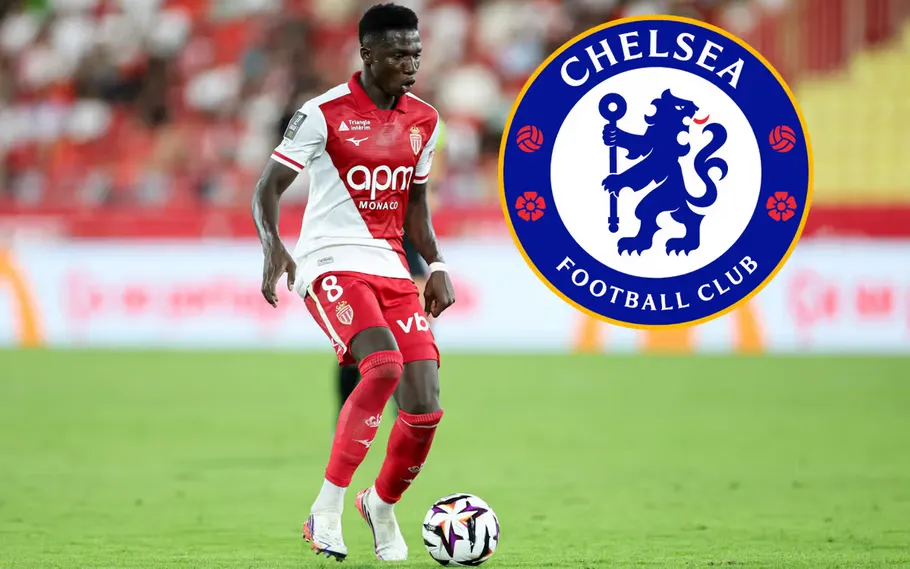
Lamine Camara has addressed the collapse of his proposed £47m move from Monaco to Chelsea, making clear that he has refocused on his current club while declining to rule out another opportunity in the future.
The Senegal midfielder’s first public comments since deadline day do not amount to a demand for a renewed Chelsea approach. But they do establish that the failed transfer has not hardened into a definitive rejection of the Premier League club. Camara said the prospect of leaving had existed, that the move fell apart very late, and that his immediate priority is contributing to Monaco’s season.
A deal that remains disputed
Multiple outlets agree on the central sequence: Chelsea made several approaches, Monaco eventually accepted terms in the region of £47m, and the transfer then failed after the window had closed. The reporting also broadly connects Monaco’s reversal to uncertainty surrounding Folarin Balogun’s proposed move to Everton, which would have altered the French club’s attacking options.
There are, however, important details that remain contested or incomplete. Chelsea-connected accounts say there was a written agreement between the clubs and portray Monaco’s withdrawal as an abrupt reversal. Monaco sporting director Thiago Scuro has rejected the suggestion that his club acted improperly, arguing that high-pressure deadline-day negotiations routinely involve changing circumstances.
That distinction matters. One version presents Chelsea as having completed the essential club-to-club work before being denied the player; the other treats an agreement at that stage as part of an unfinished negotiation rather than an irrevocable outcome. Neither set of reporting fully clarifies the contractual status of the documents, or precisely what condition changed Monaco’s position.
The financial detail is also not entirely uniform. One report describes a £47m fixed payment, while another puts the final arrangement at £47.2m after earlier bids of £38.5m and £42.9m were rejected. The small gap does not change the scale of Chelsea’s intended investment, but it underlines how little of the final structure has been confirmed publicly.
Camara's measured response
Camara’s remarks are notable for what he avoided as much as what he said. He did not publicly criticise Monaco, and he did not confirm that he had pushed to join Chelsea. Instead, he framed the episode as an unwelcome but familiar part of a player’s career and stressed his wish to remain fully committed to Monaco.
That approach protects all parties. Monaco retain a player they clearly value, while Camara avoids creating tension in a dressing room that has started the Ligue 1 campaign strongly. At the same time, his acknowledgement that another opening may arise leaves his longer-term future unresolved.
For Chelsea, that is more useful than a categorical refusal but considerably less significant than a January agreement. A player’s openness cannot repair the practical obstacles that ended the summer deal: Monaco’s willingness to sell, the timing of any replacement business and the eventual terms required. Chelsea would also need to decide whether Camara remains the right profile once the season has developed.
Alonso signals no immediate need
Xabi Alonso has offered the clearest indication that Chelsea are not treating Camara’s failed arrival as an emergency. The Chelsea manager has said he is satisfied with the balance and depth of his group, emphasising the value of certainty after the transfer window.
His assessment carries added weight because reports say Chelsea allowed Enzo Fernandez to join Manchester City for £125m on deadline day while attempting to bring in Camara. If that account is accurate, the pursuit was not merely opportunistic; it was connected to a major change in Chelsea’s midfield resources. Yet Alonso’s public stance suggests he sees no advantage in revisiting an acrimonious negotiation immediately.
That does not eliminate the possibility of a later return. Chelsea now know the broad valuation Monaco attached to the 22-year-old and have evidence that Camara was prepared to contemplate a move. Conversely, Monaco have several months in which strong performances could increase both his importance to the team and his market value.
Chelsea’s first post-window test against Hull City offers a more immediate measure of Alonso’s confidence in the available squad. OwnOdds gives Chelsea a 47% chance of winning, against 24% for a draw and 29% for Hull, with model confidence at 52% in its Chelsea vs Hull City prediction. The fixture will not settle the Camara question, but the midfield’s functioning without a replacement will inform how urgent it appears by January.
For now, the transfer is best viewed as postponed rather than revived. Camara has left space for future interest, but Monaco’s public defence of their deadline-day choice and Alonso’s contentment with his squad mean there is no clear evidence of an imminent second attempt.