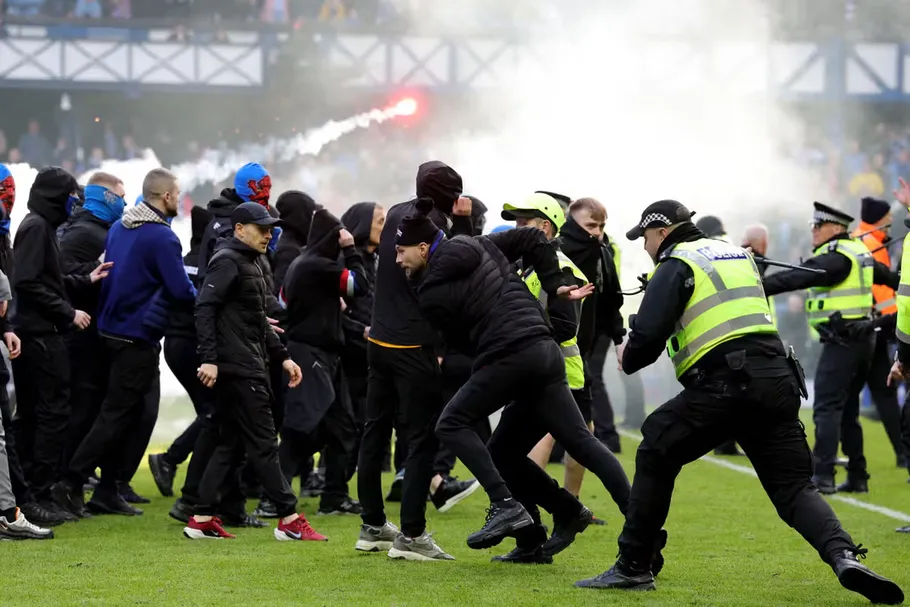
Celtic and Rangers must stage their next home matches in the Scottish Cup without spectators after the Scottish FA ruled on the disorder following last season’s Ibrox quarter-final. Each club has also been told to pay £100,000 to the opponent affected by the lost ticket income.
The punishment follows Celtic’s penalty-shootout win in March, after which fans entered the playing surface and confrontations developed around the pitch. Arrests were made, missiles including pyrotechnics were reported, and officers were among those injured. Both clubs accepted disciplinary charges relating to their failure to control unacceptable behaviour.
The immediate consequences are limited to the next Scottish Cup home tie for each side. But the ruling contains a significant further deterrent: further relevant misconduct within the competition over the next two seasons would bring another match without fans.
A sanction aimed beyond one derby
The timing means neither club yet knows precisely which fixture will be affected. Premiership teams do not join the Scottish Cup until January, so the next home tie could be a routine early-round meeting or another high-profile encounter. The forthcoming League Cup and Premiership derbies are not covered by this particular decision.
That distinction matters. A closed-door Scottish Cup match is not an all-competitions stadium ban, but it still removes an important part of the occasion and creates a direct commercial cost. The compensation order is designed to ensure that a visiting side is not left paying for an incident it did not cause while being deprived of its usual allocation and associated revenue.
The sanction is notably stronger than the fines and ticket restrictions more often used in Scottish football for crowd issues. Multiple reports portray it as a consequence not only of what happened at Ibrox, but of concern that previous penalties have not sufficiently changed behaviour around major fixtures.
Same outcome, different arguments
The two clubs have received the same sporting punishment, although the circumstances described in the reporting are not identical. Rangers were the home club and responsible for the stadium operation at Ibrox. Celtic’s position is that a limited number of their supporters went onto the field in celebration, and that this should be separated from the more serious confrontations that followed.
Celtic have called the decision excessive and indicated they will examine the written reasons before deciding what action to take. Rangers had not publicly responded at the time of the reports.
That leaves an important question over how the disciplinary panel allocated responsibility. The judicial process heard from both clubs and both admitted the charges, but the public accounts do not yet spell out how much weight was given to home-club safety planning, visiting-supporter conduct, policing, stewarding and the sequence in which people reached the pitch.
An independent review of the incident concluded that the situation came perilously close to a far more serious collective confrontation. It identified shortcomings on both sides and also criticised the Scottish FA's own prior handling of crowd disorder. In that context, equal sanctions can be read as an attempt to establish joint institutional responsibility rather than as a finding that every action on the day was equivalent.
The governing body is under scrutiny too
The ruling places pressure on Celtic and Rangers, but it does not erase the questions raised for the Scottish FA. The independent review reportedly argued that the governing body had not acted firmly enough in earlier cases. A tougher punishment now may establish a clearer threshold, yet its credibility will depend on consistent application when comparable incidents arise elsewhere.
There is also a practical issue for the clubs to resolve before their next Cup home games. A fixture without supporters requires more than simply closing turnstiles: season-ticket arrangements, hospitality, broadcasters, staffing and the financial settlement with the visiting club all need to be managed. Neither side can treat the sanction as merely symbolic.
For supporters, the decision is a reminder that the cost of disorder is increasingly being attached to access to matches rather than only to club balance sheets. The prospect of a second behind-closed-doors Cup tie during the next two seasons is intended to make prevention a priority well before a flashpoint develops.
The next phase will be shaped by the panel’s detailed reasoning and whether Celtic choose to challenge the outcome. Whatever follows procedurally, Scottish football has drawn a sharper line: the authorities now appear prepared to remove fans from fixtures when safety failures surrounding major rivalries cross that line.