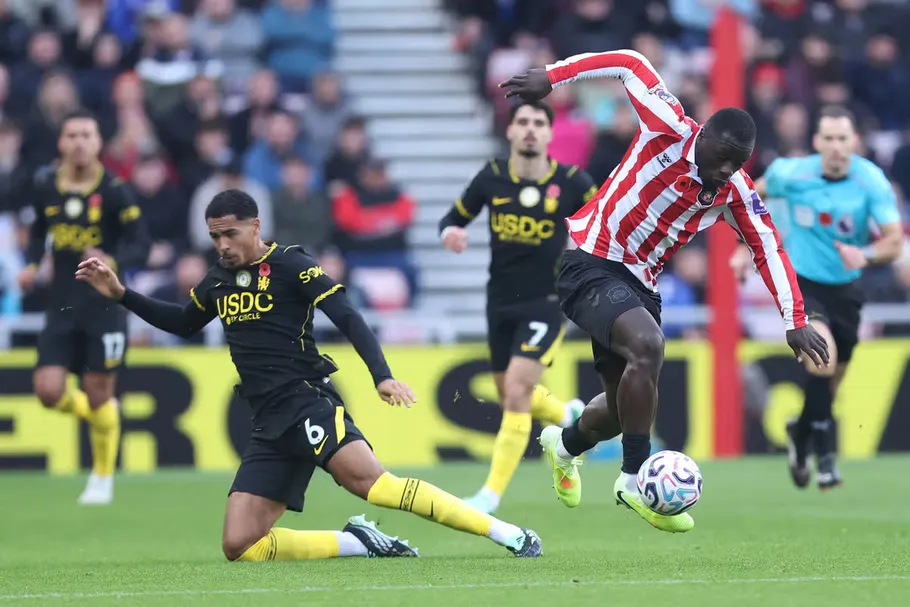
Chelsea lost 1-0 at Sunderland after Enzo Le Fée converted a disputed first-half penalty, but the controversy surrounding the winner could not disguise their attacking shortcomings. Xabi Alonso changed personnel and reshaped his side after the interval without finding an equaliser at the Stadium of Light.
Brian Brobbey’s physical presence unsettled Chelsea before the decisive incident, while Cole Palmer and Morgan Rogers struggled to influence proceedings. Mike Penders’ late save from Wilson Isidor kept the visitors within reach, yet their greater possession after the break brought no reward.
The defensive ratings were severe, although the accounts differ over individual responsibility. The more consistent message across the reports is that Chelsea failed to turn their midfield platform into enough meaningful attacking opportunities.
A disputed penalty, but earlier warnings
Sunderland threatened well before Le Fée scored. Brobbey missed from a Chemsdine Talbi delivery and later broke forward following a loose Chelsea pass, with Wesley Fofana helping direct him away from a more favourable shooting position.
Those moments matter because the penalty was not an isolated interruption to an otherwise comfortable defensive performance. Sunderland had already demonstrated that they could reach dangerous areas through both service from wide positions and quick transitions.
The award itself remains contentious in the supplied accounts. Both describe significant contact between Brobbey and Levi Colwill, with the more detailed match report arguing that the striker pulled the defender’s shirt before falling. That account also says the decision survived a VAR check. Those descriptions establish why Chelsea could feel aggrieved, rather than independently resolving whether the referee was correct.
There is also a notable inconsistency in the player assessments. One assigns Fofana a four-out-of-ten rating and links him to the penalty and half-time withdrawal, yet its own substitution details identify Colwill as the player replaced. The other gives Colwill three and Fofana five, naming Colwill as the defender penalised.
That discrepancy makes a simple verdict about which defender cost Chelsea the match unreliable. The broader concern is clearer: Brobbey repeatedly forced their back line into uncomfortable decisions.
Possession without a convincing focal point
Chelsea’s attacking problems were less disputed. Pedro Neto worked at the front of the side but offered limited influence, while Palmer and Rogers were unable to provide the interventions expected of them.
Marco Palestra did supply an inviting first-half cross, only for Rogers to head over. Palmer also had a potential penalty incident reviewed, with the foul judged to have occurred outside the area, according to the match report. Neither episode developed into the breakthrough Chelsea needed.
The selection raised a structural question. With Jordan Henderson, Romeo Lavia and Moises Caicedo all starting, Chelsea had considerable midfield resources but no conventional centre-forward leading the attack. Neto’s movement could offer a different problem for defenders, but the reports suggest Chelsea struggled to complement it with a reliable presence near goal.
That does not prove a recognised striker would have changed the result. Danny Welbeck’s subsequent introduction produced little improvement, and one assessment records a missed header in added time. It does suggest the issue extended beyond the identity of the starting forward: Chelsea could not consistently connect their possession to threatening final actions.
Changes altered the shape, not the outcome
Estevao entered at half-time, with Caicedo moving into central defence. Welbeck and Malo Gusto followed, before Geovany Quenda and Emmanuel Emegha were introduced later.
There were individual signs of impetus. Estevao carried the ball past opponents, while Quenda quickly forced a corner. But neither account describes sustained attacking control that translated into a succession of clear openings.
The reshuffle also carried a trade-off. Moving Caicedo backwards helped accommodate an additional attacker, but it changed the midfield structure rather than simply adding firepower to the existing arrangement. More attacking personnel did not automatically mean better attacking connections.
Lavia received positive assessments in both reports, whereas Henderson’s contribution divided opinion sharply. That distinction is useful: Chelsea’s midfield was not uniformly ineffective, but competent circulation and individual composure were insufficient against an opponent defending a lead.
Penders’ save from Isidor underlined the remaining danger at the other end. Sunderland could still threaten while Chelsea chased the game.
For Alonso, the central lesson is therefore wider than the disputed penalty or a harsh defensive rating. Chelsea needed both greater security against direct attacks and a clearer route from midfield possession to chances. On this occasion, their adjustments delivered neither an equaliser nor a convincing answer to that imbalance.