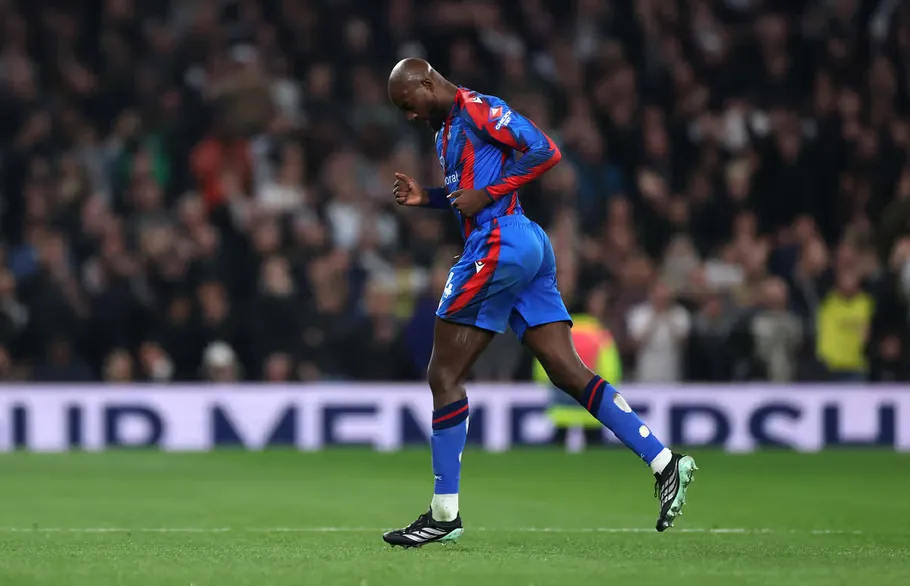
Crystal Palace have lodged an appeal against Jean-Philippe Mateta’s dismissal at Tottenham, seeking to prevent or shorten a three-game suspension that would remove the striker from a significant stretch of their Premier League schedule.
The France international was sent off 13 minutes into Saturday’s 2-0 defeat after catching Micky van de Ven around the back of the ankle. Michael Oliver first booked Mateta, then changed his decision following a pitchside review prompted by VAR official Jarred Gillett.
According to multiple outlets, Palace regard the collision as inadvertent. Their argument centres on Mateta watching the ball while pursuing a pass, rather than seeing the defender enter his path. The officials’ explanation, however, focused on the location, force and speed of the contact. That distinction is central to understanding why the appeal is not simply a dispute about what happened.
Intent and danger are different arguments
The reports broadly agree on the sequence: Mateta pursued the ball, made contact with Van de Ven and received a yellow card before VAR intervened. There is no substantial disagreement between the accounts over those events. The competing interpretations concern how the challenge should be judged.
Palace’s position offers an explanation for the collision. It does not, by itself, settle whether the action endangered an opponent. A player can be concentrating on the ball without intending harm, yet still make a challenge that warrants dismissal because of its consequences and manner.
The officials’ reasoning, as reported, was built around studs making forceful contact near the Achilles while Mateta was moving quickly. Palace therefore need more than a persuasive account of where their striker was looking: their case must address why that contact should not carry the sanction imposed, or why the resulting suspension should be shorter.
The publicly available reporting does not establish whether Palace have submitted additional footage or technical evidence. Nor does it explain in detail how they are distinguishing their request to overturn the dismissal from their alternative aim of reducing the ban. Those omissions leave the strength of the appeal difficult to assess from outside.
An early dismissal, but not a complete explanation
The score was level when Mateta departed, leaving Palace to play most of the match with ten men. Tottenham subsequently scored through Archie Gray and Jan Paul van Hecke.
That timing matters when evaluating the defeat. Losing a centre-forward so early changes both the attacking options and the workload for those remaining, making the final score an imperfect measure of how Palace might have competed at full strength.
It would nevertheless be too strong to conclude that the red card alone decided the match. The reports establish the numerical disadvantage and the subsequent goals, not what would have happened without the intervention. An appeal can challenge a disciplinary judgement; it cannot resolve that counterfactual.
There is also some external support for the original outcome. One report notes that a television review panel, including former referee Dermot Gallagher, agreed with the dismissal. That assessment does not determine the appeal, but it underlines that Palace’s interpretation is not the only plausible reading of the footage.
Palace’s shortage raises the stakes
If the suspension stands, Mateta will be unavailable against Liverpool, Coventry and Hull. The consequences therefore extend beyond the immediate challenge of hosting Liverpool: Palace could lose their main attacking reference point across three league fixtures while Pierre Sage faces growing scrutiny.
The squad context makes that absence more difficult to absorb. Jorgen Strand Larsen is reported to be out with an ankle injury, leaving Eddie Nketiah as the only available striker. Mateta himself has only recently returned from a hamstring problem.
That combination limits Sage’s flexibility. With fewer alternatives, replacing Mateta is not merely a question of selecting another forward; it also reduces the manager’s scope to change the attack during matches.
European availability offers only partial relief
Mateta would remain eligible for the Europa League meetings with Hoffenheim and Real Sociedad, according to the reports. Palace could therefore face an uneven period in which their attacking choices differ between domestic and European games.
That availability would soften the overall disruption, but it would not solve the immediate league problem. Until the appeal is decided, Sage must prepare for Liverpool with the possibility that his already limited striking options will narrow further. The sporting incentive to challenge the sanction is clear; whether the evidence justifies changing it remains unanswered.