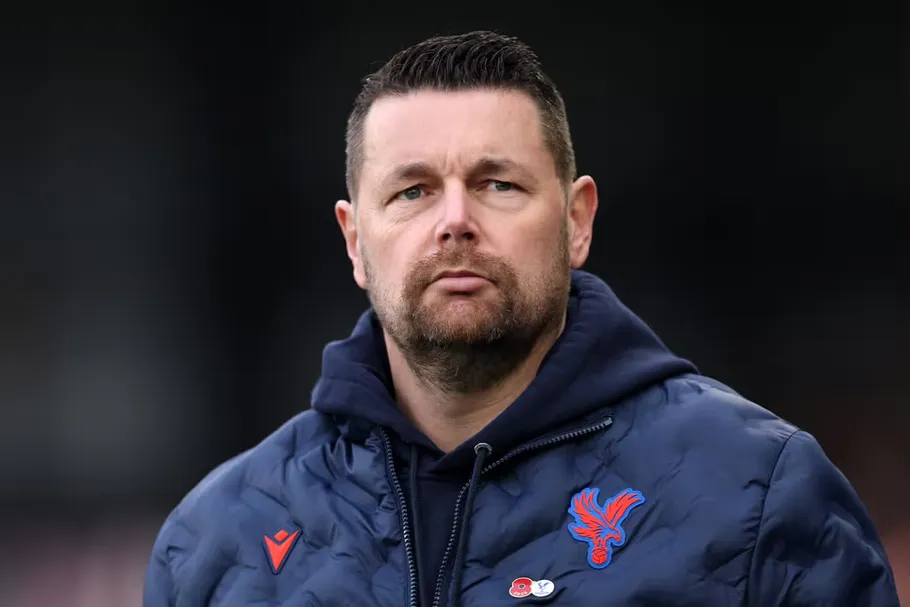
Crystal Palace dismissed Pierre Sage on Thursday after five months and 16 matches in charge, ending an appointment that was intended to build on the club’s trophy-winning period under Oliver Glasner. Palace are bottom of the Premier League following four consecutive league defeats, with Thomas Frank reportedly in advanced discussions about becoming their next manager.
Sage’s final match was a 3-1 home defeat by Liverpool. Palace confirmed that coaches Jamal Alioui, Damien Della Santa and Sandy Guichard had also departed, but did not announce a successor or identify who would oversee the squad during the recruitment process.
The decision leaves Palace confronting two connected problems: correcting an increasingly damaging defensive record and establishing why a coach recruited after substantial success in France could not make the transition work.
Defensive decline drives the decision
The strongest evidence behind Sage’s dismissal is not simply Palace’s position. It is the combination of repeated defeats and a defence that has allowed 24 goals in 10 league matches, the highest total in the division.
According to multiple reports, Palace have won twice in the league. Their four-match losing sequence began with a 5-0 defeat against Brighton, making the deterioration particularly difficult to contain: a heavy loss against their major rivals was followed by three further defeats rather than a stabilising response.
There were mitigating circumstances against Liverpool. Palace struck the woodwork and had a goal disallowed, details that suggest the final score did not capture every aspect of their performance. But those incidents cannot explain the wider defensive pattern. An argument about misfortune in one match is different from an explanation for sustained vulnerability across 10.
That distinction matters for the next appointment. Improving finishing or recovering an unavailable forward might change a close contest; reducing the frequency with which opponents score requires a more comprehensive assessment of organisation, selection and the protection offered ahead of the defence.
Context complicates the verdict on Sage
Sage arrived in June on a three-year deal after leading Lens to second place in Ligue 1 and winning the French Cup. His recruitment therefore represented a commitment to a coach with recent achievements, rather than an appointment based solely on potential.
He also inherited an unusually demanding benchmark. Glasner had delivered the FA Cup and Conference League before leaving for Nottingham Forest. Palace were asking a new manager to preserve the momentum of a celebrated period while introducing his own methods.
Reporting also identifies injuries and disruption involving Jean-Philippe Mateta and Ismaila Sarr as obstacles. Fitness concerns and issues connected to their wishes to leave reportedly affected their availability. Those circumstances complicate any conclusion that the results were exclusively a coaching failure.
What remains unanswered is how much of the breakdown Palace attribute to Sage’s approach and how much to the conditions around him. That is not an academic distinction. If squad availability and unsettled players were substantial causes, replacing the manager alone cannot remove them.
Sage’s five victories across all competitions, including progress to the League Cup quarter-finals, show that his tenure was not uniformly unsuccessful. Nevertheless, cup progress offered limited protection once the league campaign became a relegation concern.
Frank reports point towards a developing process
The reporting on Frank differs in certainty. One account describes him as a possible candidate, another presents him as the leading option, while a further report says discussions have reached an advanced stage. Those descriptions suggest movement, but they are not interchangeable, and Palace have confirmed none of them publicly.
Sean Dyche has also been mentioned as an available alternative. Until an appointment is announced, it would be premature to treat the search as concluded.
Frank’s experience at Brentford offers an obvious reason for interest, but his subsequent dismissal by Tottenham is relevant too. Reports note that he left Spurs in February after an eight-game league sequence without victory. His candidacy should therefore be assessed as a proposed fit for Palace’s problems, not as a guarantee of immediate recovery.
There is another inconsistency in the coverage: one report calls Sage the season’s first Premier League managerial dismissal, while another places him second after Michael Carrick’s departure from Manchester United on Thursday. That discrepancy does not affect Palace’s decision, but the sequence should not be presented as settled.
The central issue is clearer. Palace have abandoned a long-term appointment after a short spell because the league decline became unacceptable. Their next decision needs to identify a workable response to the defensive damage while recognising the squad difficulties that outlast Sage’s departure.