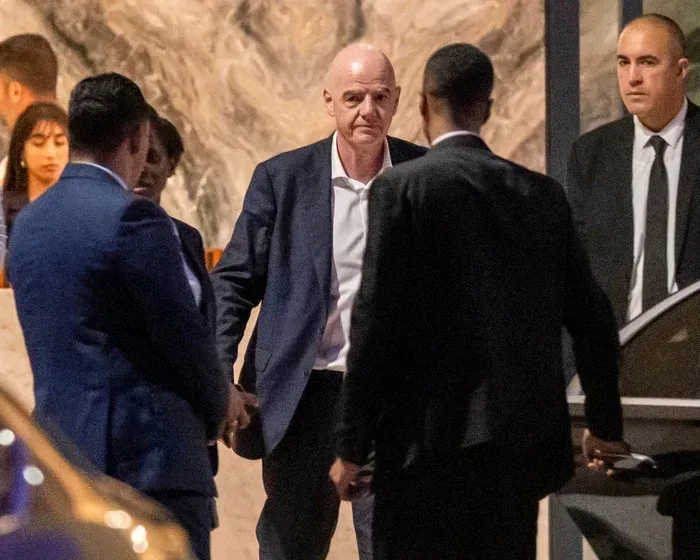
Gianni Infantino’s attempt to move beyond the abandoned plan to sell a stake in Fifa’s World Cup commercial and ticketing operation has met renewed resistance, with European football maintaining pressure on the Fifa president and some member associations publicly backing him.
Reports on Wednesday indicated that Infantino had expressed regret over how the proposed Fifa Forward Enterprise project was handled, after talks involving a select group of senior figures in Rabat. The project, which was later dropped, had envisaged private-equity investment in a 21% holding in the business.
That response has not settled the dispute. Uefa has reiterated that it has lost confidence in Infantino’s leadership, according to multiple outlets, while Norway has reportedly become the first national association to call explicitly for him to leave office. A possible European boycott of Fifa competitions remains a central point of tension.
Support outside Europe remains important
Infantino’s position is complicated by the contrasting reaction across football’s regions. Reporting suggests he continues to command meaningful support among associations in Africa and elsewhere outside Europe, where Fifa development funding and the organisation’s rising revenues have helped build durable relationships.
Mexico and Argentina were reported to have joined African associations in supporting his continued leadership, despite their different regional setting. In Colombia, Infantino attended the inauguration of new president Abelardo de la Espriella alongside Conmebol president Alejandro Dominguez, while Colombian Football Federation chief Ramon Jesurun welcomed him on arrival.
Such appearances illustrate a fundamental reality of Fifa politics: its president is elected by a worldwide membership of 211 associations, not by Europe alone. Uefa’s members carry sporting, commercial and historical weight, but a leadership challenge requires support across a far broader electorate.
The present row is therefore not simply a disagreement over one investment proposal. It is a test of whether Europe can translate its institutional influence into a coalition capable of changing Fifa’s direction, or whether Infantino’s alliances across other confederations can absorb the criticism.
A role built on access and visibility
The Fifa presidency is unusually international in scope. The office demands visits to member associations, confederation events, tournaments and Fifa-backed grassroots projects. That schedule creates a political function alongside the sporting and administrative one: maintaining relationships with national federations and, often, national leaders.
Reports have highlighted the scale and style of Infantino’s travel, including use of an executive aircraft made available through Qatar Airways and high-level security arrangements on some visits. They have also noted his remuneration, reported at approximately £4m annually when salary and variable bonus are combined, plus a per-diem allowance.
Fifa can argue that the office should be resourced to match an organisation responsible for the world’s most popular sport and major global events. Its president’s supporters can also point to greater revenue and increased funds reaching associations during Infantino’s tenure.
But the same visibility brings a higher standard of accountability. The closer the office appears to political power, the more carefully Fifa must demonstrate that football decisions are independent, transparent and properly governed.
Political ties add to the pressure
Infantino’s relationship with US President Donald Trump has become a major element of the criticism. Sources point to Infantino’s participation in political events, including travel connected to Trump, and to Trump’s prominent presence around the 2026 World Cup.
Fifa has maintained that its disciplinary structures operate independently. Nonetheless, reports about the reversal of a red-card-related sanction involving USA forward Folarin Balogun — after Trump said he had contacted Infantino — intensified scrutiny. Infantino said the outcome was reached by an independent disciplinary body not subject to outside influence.
The planned World Cup business transaction drew further attention because the prospective investor was linked in reports to the brother of Jared Kushner, Trump’s son-in-law. The overlap between commercial proposals and high-profile political relationships has made it harder for Fifa to present the episode as a narrow procedural error.
Critics, including Uefa figures, see a wider pattern in the expansion of competitions, ticketing policies and the concentration of decision-making. Defenders of Infantino are likely to counter that expanded events and commercial growth create the revenue from which national associations benefit.
The next institutional test
The immediate question is whether Uefa acts on its boycott warning. Such a step would be exceptionally disruptive, particularly if it affected a World Cup or another major Fifa event. It would also risk widening the divide between Europe and confederations that view Fifa’s current strategy more favourably.
A boycott is not the only route open to dissatisfied associations. They can seek governance reforms, use Fifa’s internal mechanisms or organise around the next presidential election. Yet each path depends on numbers as much as public criticism.
Infantino’s statement of contrition may have been intended to close the issue. Instead, it has exposed the competing ideas of what Fifa should be: a commercially expansive global body led through strong presidential diplomacy, or an institution in which its biggest assets and decisions face tighter collective oversight.
The outcome will depend less on ceremony and travel than on whether Fifa’s membership accepts the explanation for the abandoned plan — and whether its regional blocs remain united when the next formal test arrives.