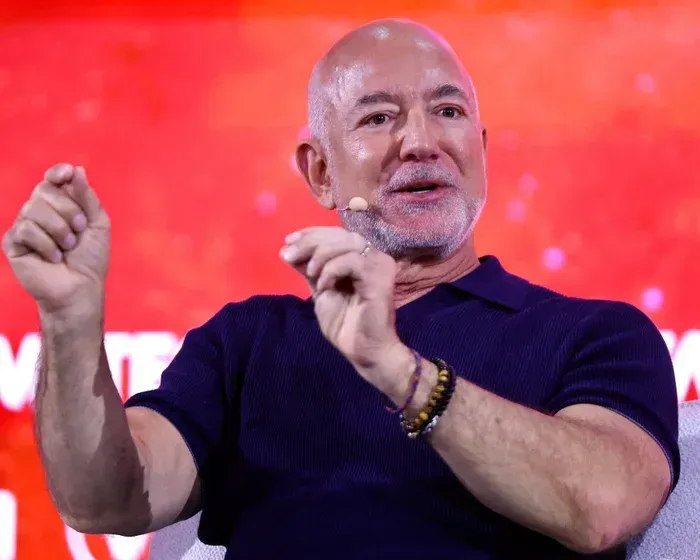
Reports on Wednesday indicated that Jeff Bezos is part of a consortium considering the purchase of roughly 30% of Liverpool, in a deal that would place a proposed £4.4bn valuation on the club.
Eduardo Saverin, the Facebook co-founder, and businessman Amit Bhatia were also named in the reporting around the prospective investment. No completed transaction was confirmed, but the possibility has immediately renewed debate over what further outside capital could mean for one of English football’s most prominent institutions.
A minority stake with major implications
A sale of about 30% would not necessarily alter Liverpool’s day-to-day control. Fenway Sports Group, which has owned the club since 2010, would remain central to the ownership structure if the reported arrangement is completed. Yet a minority investment at the valuation discussed would be significant well beyond the percentage changing hands.
It would underline how sharply the value of elite clubs has risen. FSG bought Liverpool for £300m amid severe financial difficulties 16 years ago, according to the reports. A £4.4bn valuation would represent a dramatic increase in the worth of the asset, reflecting the club’s sporting success, worldwide audience, commercial reach and the escalating price placed on major football brands.
Bezos’s inclusion naturally draws particular attention. As Amazon’s founder and one of the world’s wealthiest individuals, he represents the kind of investor whose resources can reshape assumptions around the financial ceiling of a club. But personal wealth and club strategy are not automatically the same thing. The extent to which a minority shareholder would provide new funding, influence governance or simply acquire a stake in a valuable sports property would be fundamental to assessing the proposal.
The ownership question at Liverpool
Liverpool’s modern history already contains sharply contrasting American ownership experiences. The period under Tom Hicks and George Gillett became associated with debt, instability and a mounting threat to the club’s future before FSG’s takeover in 2010.
FSG subsequently presided over an era in which Liverpool returned to the summit of English and European football, winning the Premier League and Champions League. It also developed Anfield, expanded the club’s commercial profile and strengthened its status as a global sporting business.
That record does not remove the questions that accompany a potential sale to another group of ultra-wealthy investors. Liverpool’s identity has long been linked to the city and to a supporter culture that views the club as more than a balance-sheet asset. The tension between those traditions and the increasingly corporate economics of elite football is unlikely to disappear because the reported deal concerns a non-controlling stake.
For some, additional investment could be seen as a practical response to a landscape in which the leading clubs compete for players, infrastructure and commercial opportunities on an enormous scale. For others, it may deepen unease about football clubs becoming vehicles for investors whose connection to local communities is primarily financial.
Money does not settle sporting issues
The reported valuation also arrives at a moment when the limits of wealth in football are clear. Liverpool have been able to spend heavily in recent transfer windows, with one report noting a £446m outlay in a single summer, but expenditure alone does not guarantee a balanced squad or a smooth adaptation to a manager’s approach.
Recruitment requires coherence as much as scale. A club can possess substantial resources and still face difficult choices over player profiles, contract timing, succession planning and how quickly a new tactical framework can take hold. An investment deal, even one involving globally recognised billionaires, cannot by itself resolve those sporting decisions.
That is particularly relevant for Liverpool because expectations are set by their recent success. The club’s supporters will judge the direction of travel through performances, trophies and the preservation of a recognisable identity, rather than through the size of a valuation alone.
What remains unclear
The important details remain unresolved. Reports did not establish whether the consortium has reached an agreement with FSG, what rights would be attached to the stake, or whether the money would be retained by the ownership group, invested into the club or used in another way.
Those distinctions matter. A passive minority holding is different from an arrangement that gives investors meaningful board representation or influence over major decisions. Equally, a headline valuation is not the same as an immediate increase in Liverpool’s available football budget.
Until there is clarity from the parties involved, the story is best understood as a signal of Liverpool’s place in the global investment market. The proposed involvement of Bezos, Saverin and Bhatia suggests that the club’s appeal now extends far beyond Merseyside. Whether that appeal can be reconciled with the values supporters expect from Liverpool will be the more consequential question.