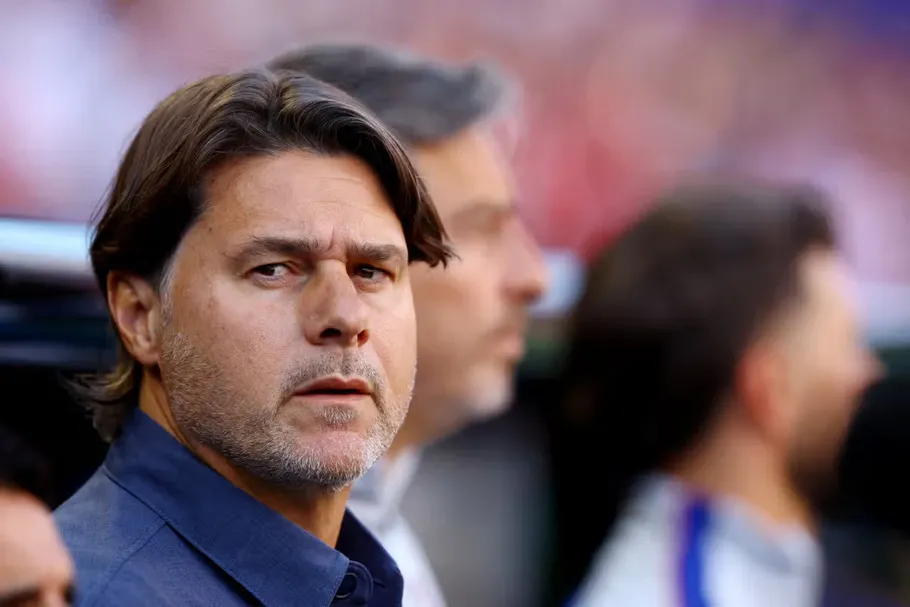
Manchester United are moving towards appointing Mauricio Pochettino, according to reports on Wednesday, but an agreement with US Soccer and a formal decision on Michael Carrick’s future remain unresolved. The reporting points towards a managerial change without establishing that either Carrick’s dismissal or Pochettino’s arrival has been completed.
United’s hierarchy is expected to discuss the position at a meeting in Monaco. Pochettino has emerged as the leading candidate, but the distinction between identifying a preferred replacement and securing his release is central to understanding where the process stands.
Carrick decision remains a separate step
The reports differ in how firmly they describe Carrick’s departure. One presents his dismissal as the expected outcome of an advanced move for Pochettino. Another explicitly states that the final decision has not yet been taken and that Carrick remains in charge.
Those accounts are not necessarily incompatible: a club can prepare a replacement while its existing manager remains employed. They do, however, leave an important limit on what can be concluded. Preparations for a change are not confirmation that the change has been authorised.
Chief executive Omar Berrada and director of football Jason Wilcox are reportedly likely to recommend a dismissal to co-owner Sir Jim Ratcliffe. That places the immediate decision inside United, even as negotiations involving Pochettino’s current employer become increasingly significant.
The uncertainty also makes this more than a straightforward recruitment exercise. United must align their internal decision with an external release agreement, rather than assuming that progress on one automatically settles the other.
A release clause does not settle every issue
According to the reporting, Pochettino’s US Soccer contract contains a compensation provision worth an initial $7 million, approximately £5.3 million. His agreement runs through the 2030 World Cup, having been extended in August.
That reported clause provides a financial starting point. It does not establish that the entire move can be completed for that sum, or that payment alone determines when Pochettino would be free to take charge.
Additional compensation is reportedly required for his coaching staff, including long-serving assistant Jesus Perez. No total figure for securing the wider group has been reported in the supplied accounts.
This matters because United would be recruiting more than an individual manager. If Pochettino’s intention is to arrive with his established assistants, their contractual positions become part of the practical agreement. The headline compensation figure therefore describes only one component of a potentially broader negotiation.
Neither account establishes that all those terms have been accepted. Describing the financial clause as manageable should not be confused with treating the release process as complete.
Pochettino’s commitment needs context
Pochettino’s recent comments about his US role offer a more nuanced picture than either an unconditional promise to stay or an invitation to leave.
In September, he distinguished the commitment he had made before the home World Cup from the longer agreement that followed it. His explanation suggested that a four-year contract allowed for circumstances to change, while still expressing enthusiasm for continuing towards 2030.
Those remarks help explain why an approach from United might be considered without proving that he had already decided to return to club management. They describe his view of a long contractual commitment, not an agreement with a particular club.
Reports that he is interested in United, and that the parties have held discussions on previous occasions, strengthen the case that this is a credible pursuit. They do not answer the outstanding questions over his release, staff or final employment terms.
What an agreement would still need to resolve
US Soccer is reportedly prepared for the possibility of Pochettino leaving before 2030 and has a succession plan. That could reduce the disruption of an exit, but organisational preparation is not the same as consent to United’s preferred terms.
The federation has its own sporting responsibilities and contractual interests. United’s desire to move quickly does not remove those considerations, even if the compensation mechanism makes an eventual departure easier to negotiate.
The strongest conclusion from the reports is that Pochettino is the leading option in an active process. The weakest is the suggestion that only a routine administrative step remains.
Until United confirm their decision on Carrick and the relevant parties settle Pochettino’s release, this remains an advanced managerial pursuit rather than a completed appointment. The decisive development will be agreement across those separate issues, not simply another indication that United want him.