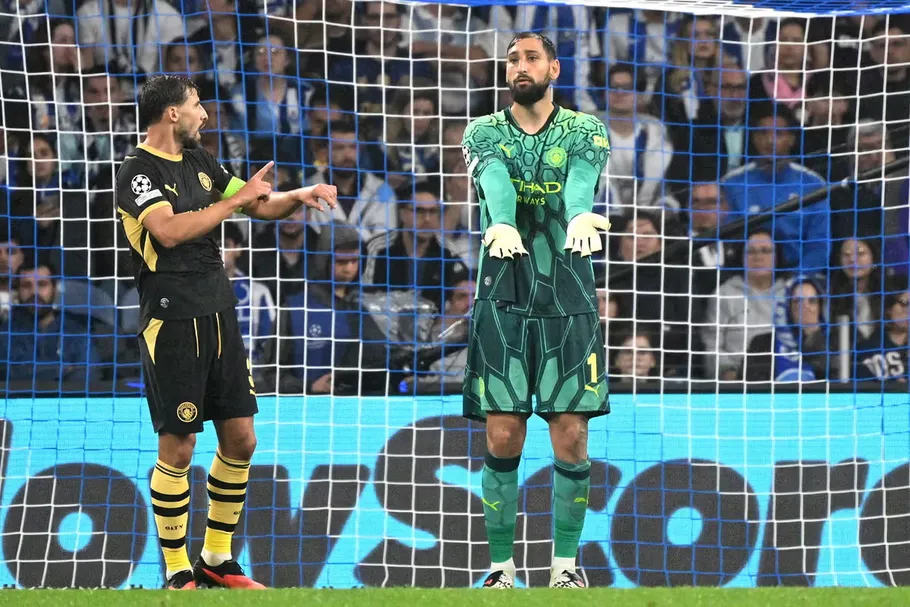
Enzo Maresca has reaffirmed his support for Gianluigi Donnarumma after another costly mistake in Manchester City’s Champions League victory at RB Leipzig, making clear that he is not currently considering a reassessment of the goalkeeping position during the international break.
Speaking before Saturday’s trip to Nottingham Forest, the City manager acknowledged the goalkeeper’s responsibility for Leipzig’s first equaliser in Wednesday’s 3-2 win. His response, however, was to distinguish an error that needs correcting from a broader problem requiring intervention.
That distinction matters after further mistakes against Paris Saint-Germain and Aston Villa. Donnarumma’s performance in Germany has added to the scrutiny, but Maresca’s public position remains that the Italian understands what went wrong and does not need an extended discussion to recognise it.
Support is not the same as dismissal
The reports agree on the central facts: Donnarumma was beaten at his near post in Leipzig, endured other uncertain moments and also produced an impressive save. Where they differ is in the weight attached to those elements.
Some coverage presents the latest performance as evidence of a sustained deterioration. Maresca instead emphasises the coexistence of decisive saves and preventable mistakes. Those readings are not directly contradictory, but they address different questions: whether Donnarumma has recently been reliable, and whether City’s manager believes he remains the right goalkeeper.
The answer to the first is under pressure. The answer to the second, based on Maresca’s comments, is still yes.
Importantly, the manager has not argued that the Leipzig goal was unavoidable. His backing rests on accepting the mistake without allowing it to define the player’s entire contribution. He also described Donnarumma as composed and quick to identify his own errors, explaining why he sees little benefit in an intensive conversation about each incident.
That is an individual approach to managing confidence, rather than evidence that the technical issue has been resolved. None of the reporting establishes whether the recent mistakes share a common cause. A sequence of conspicuous errors can justify concern without, by itself, explaining what needs to change.
City’s wider defensive question
The Leipzig result offers reasons both to support Maresca’s patience and to question how sustainable City’s current balance is.
City went ahead twice and were brought level on both occasions before Erling Haaland supplied the winner in the 78th minute. Maresca regarded both concessions as preventable, extending the discussion beyond the goalkeeper’s handling of the first equaliser.
That wider assessment is significant. Focusing exclusively on Donnarumma risks treating every defensive setback as a selection issue, when the manager’s own account suggests a broader need to reduce avoidable concessions. Equally, collective improvement cannot remove the goalkeeper’s responsibility for shots he should stop.
The two problems therefore need separate answers. City must improve the situations they allow to develop, while Donnarumma must make those situations less costly when they reach him. Public reassurance can protect the working environment, but the next performances will provide a clearer test of progress than the tone of a press conference.
Maresca also pointed to the relatively short period he has spent with the squad, describing a relationship still developing after four months. That supplies context for imperfect coordination, although it cannot establish that every recent mistake is a consequence of adjustment.
Forest provides the immediate test
With Nottingham Forest next, Maresca has chosen continuity over signalling a possible change. His refusal to turn the international break into a deadline for reviewing the position limits the immediate uncertainty around Donnarumma, without amounting to a permanent guarantee.
There is another useful contrast within City’s Leipzig performance. Elliot Anderson created Haaland’s winning goal, yet Maresca still sees substantial room for the midfielder to develop, including in his understanding of different roles. Praise and correction are operating together, just as they are in the manager’s assessment of his goalkeeper.
Anderson’s return to Forest will attract attention, but the more consequential issue for City is whether their attacking output can be accompanied by greater defensive control. Another recovery win would demonstrate resilience; it would not necessarily answer the concerns exposed in Germany.
For Donnarumma, the immediate task is narrower than the surrounding debate suggests: retain the match-saving interventions while cutting out the avoidable concessions. Maresca has made his confidence clear. What remains unanswered is how quickly that confidence will be matched by a more dependable run of performances.