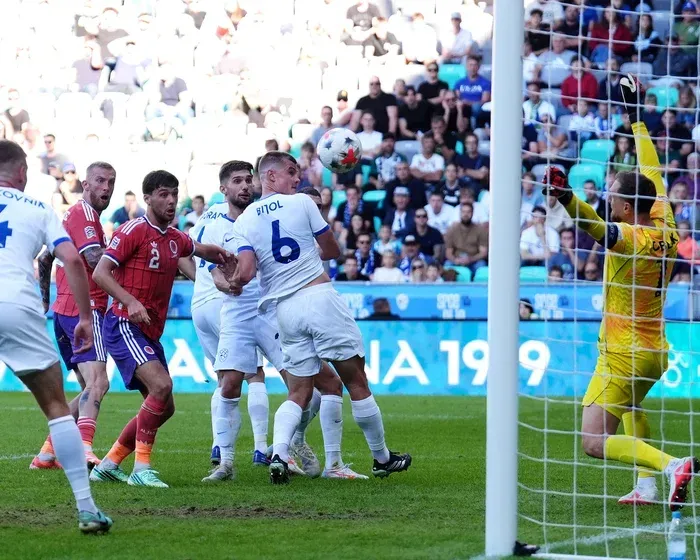
Scotland’s new era under Sebastien Pocognoli began with a goalless Nations League draw in Slovenia, a result defined by two sharply different halves and an old problem in front of goal.
Pocognoli’s side were second best before the interval in Ljubljana, but took control after the restart and created enough clear opportunities to win. Oli McBurnie, Robbie Ure, Billy Gilmour, Kieron Bowie and Aaron Hickey were all involved in chances, while Jan Oblak made important saves for the hosts. Scotland nevertheless left without a goal for the third match in succession.
The point was not presented as a complete success, but neither was it treated as a false dawn. The evidence from Pocognoli’s first match was that Scotland can generate more pressure and more penalty-area situations than they did in a passive opening 45 minutes. The unanswered question is whether that improvement can become a repeatable attacking identity rather than another match remembered principally for chances missed.
A debut split in two
Multiple reports agree that Slovenia had the better of the first half. An early Slovenian goal was disallowed, the home side struck the woodwork twice, and Scotland struggled to establish possession or press with any coherence.
That mattered as much as the later attacking display. Pocognoli chose a 3-4-1-2 shape, pairing McBurnie with debutant Ure, but a system with two centre-forwards depends on reliable progression from midfield and wing-back areas. In the first period, Scotland’s forwards were too often detached from the play. Ure’s effort against the post was their main moment of threat.
There is some difference in emphasis among the accounts of why Scotland looked uncomfortable. One focused on a defence whose personnel appeared unsuited to their particular positions; another stressed the difficulty caused by Slovenia changing their structure between defending and building attacks. Pocognoli himself pointed to the latter, saying his team had expected a back five but found a back four when Slovenia had the ball.
Those explanations need not be mutually exclusive. A new coach’s first selection, unfamiliar positional relationships and an opponent’s changing shape can all produce a hesitant first half. More encouragingly for Scotland, the response did not require wholesale substitutions. It came through adjustments to spacing and roles.
Gilmour became the reference point
Pocognoli explained that Scotland altered their midfield balance at half-time, with two deeper midfielders and two more advanced players, while Gilmour operated from a lower position. That gave Scotland a clearer first pass out of pressure and helped them regain the ball in more compact areas.
The tactical shift was visible in the flow of the game. Scotland pressed higher, attacked sooner after turnovers and got McBurnie closer to Slovenia’s central defenders. Gilmour increasingly connected the phases, combining with McBurnie for one opening and releasing Bowie for another.
This is perhaps the most substantial positive from the draw. Scotland did not merely throw bodies forward late on; they found a structure that allowed their pressing and possession game to reinforce each other. Pocognoli highlighted the increased work without the ball from his forwards, suggesting he sees that labour as part of the explanation for some tired finishing.
That is a reasonable short-term reading, but it raises a longer-term balance to solve. A front line can press aggressively and still be expected to finish decisive opportunities. Scotland require the intensity Pocognoli wants without asking the same attackers to arrive in the box depleted at the crucial moment.
Chances created, but no evidence of a cure
The manager was right not to reduce the entire performance to missed chances. Oblak, an elite goalkeeper, played a material role in the stalemate. Yet Scotland’s best openings also exposed familiar indecision. McBurnie attempted to take the ball around Oblak when a quicker finish was available, while Bowie fired wide after being sent through.
McBurnie’s return was symbolically important. He had not played for Scotland for years and was selected alongside Ure in a clear signal that Pocognoli intends to test different attacking combinations. But his international record remains goalless after 17 appearances, underlining why one promising performance cannot settle the centre-forward debate.
Ure offered movement, link play and a willingness to stretch the defence, even if his debut did not bring a breakthrough. Bowie’s arrival added another threat and Gannon-Doak was introduced as Pocognoli pushed further forward. The new coach therefore has options of differing profiles, but not yet a proven international scorer around whom the attack can be built.
The absence of Scott McTominay also provides context. Scotland missed a midfielder who has often supplied their most significant goal threat. His absence does not excuse missed one-on-ones, but it does show why the task is broader than selecting the right striker. Goals may have to come from better timing of midfield runs, more productive wide delivery and a collective ability to turn sustained pressure into cleaner shots.
Positivity needs a sharper edge
Pocognoli’s upbeat assessment reflected the travelling support’s response and Scotland’s second-half authority. A clean sheet, resilience during an uncomfortable opening spell and a visible tactical correction are all useful foundations for a manager in his first game.
Still, the draw leaves the central issue intact. Scotland were able to overwhelm Slovenia for long periods but could not make that dominance count. Pocognoli has quickly shown he can alter the rhythm and shape of his side within a match. The harder part will be making their final action as clear as their second-half intent.