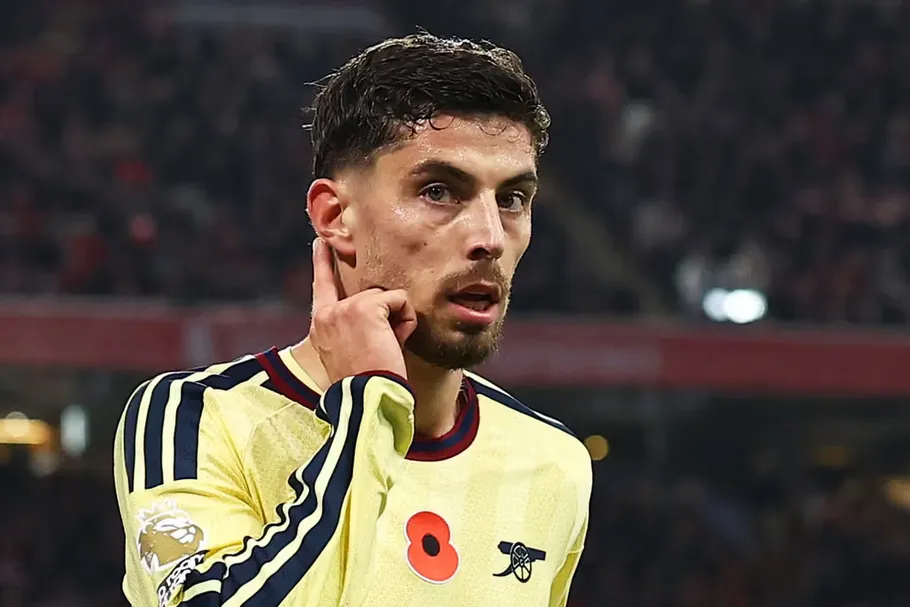
Kai Havertz gave Arsenal a 16th-minute lead at Anfield, finishing a move built on aggressive pressing and Declan Rice’s overlapping run, before Liverpool responded with sustained pressure. The latest supplied updates had the visitors leading 1-0 after 27 minutes, with neither their advantage nor their control secure.
The goal rewarded Arsenal’s growing influence in midfield after an unsettled opening. Yet Liverpool’s reaction quickly changed the contest: Bradley Barcola threatened repeatedly, Alexander Isak tested the space around Arsenal’s defenders, and David Raya had to intervene as the hosts pursued an equaliser.
For Arsenal, seeking their first league victory at Liverpool since 2012, this was an encouraging start rather than evidence that a longstanding obstacle had been overcome.
Arsenal turn pressure into penetration
The reports agree on the essential sequence behind the breakthrough. Alisson’s distribution left Liverpool vulnerable, Martin Odegaard helped force the turnover, and Arsenal transferred possession towards the right before Rice delivered the low cross that Havertz converted at the far post.
What distinguished the move was not simply the high regain. Arsenal supplied a runner beyond the player receiving the ball, turning possession near Liverpool’s penalty area into an opening across goal. Rice’s movement outside Jurrien Timber made Liverpool defend a changing angle rather than a static attack.
That matters because Arsenal’s midfield influence had not initially produced equivalent danger. The live coverage questioned whether their central combination offered enough attacking thrust; almost immediately, Rice provided it by leaving that central area.
The sequence suggests the solution was less about adding another attacker than varying where an existing midfielder appeared. Havertz benefited from a chance requiring positioning and timing rather than an elaborate finish, a useful response to the scrutiny of his recent finishing described in the reports.
Rice’s recovery work proves equally important
Rice’s contribution at the other end followed almost immediately. Raya’s misplaced pass offered Barcola an opening, but the midfielder recovered to challenge before Liverpool could exploit it.
Accounts differ slightly in emphasis: one foregrounds Rice’s intervention, while another notes that Barcola’s touch helped make the recovery possible. Both support the same broader conclusion. Arsenal’s lead survived an avoidable error because the next defensive action was effective.
That is an important distinction when assessing their opening. Arsenal were not shutting Liverpool out through flawless possession or complete territorial command. Their protection also depended on covering runs, rapid reactions and defenders closing routes towards goal.
Rice therefore embodied both sides of their approach: the freedom to advance that created the lead, and the capacity to repair danger when possession was lost. Maintaining that balance was already becoming central to the match.
Liverpool find threat without the final connection
Liverpool’s strongest response came through Barcola, whose speed and movement repeatedly unsettled Arsenal. He attacked outside Rice on one occasion and supplied another cross that travelled beyond Isak. Elsewhere, a delay before a possible cutback allowed Arsenal to recover their defensive positions.
These incidents should not all be treated as equivalent chances. Some were promising situations rather than clear opportunities to score. The distinction explains how Liverpool could look dangerous without having equalised by the latest update.
Their challenge was to connect the initial break with a decisive final action before Arsenal’s defenders could reorganise. Barcola was helping them reach threatening areas; the timing and accuracy of the next pass remained less reliable.
Liverpool also threatened from a set piece, with Virgil van Dijk helping a corner towards Isak and Raya blocking the striker’s close-range involvement. That offered a different route through a defence increasingly occupied by wide attacks.
An open contest, not a settled pattern
Arsenal retained opportunities as Liverpool pushed forward. Around the 25-minute mark, Madueke’s involvement at the far post ended with Timber obstructing the ball, before Rice shot at Alisson. The reports differ over whether Madueke was attempting a finish or directing the ball across goal, so the sequence should not be presented as an unequivocal missed scoring chance.
There is also a material disagreement in the pre-match reporting: one outlet described Liverpool as having won five consecutive matches across competitions, while another placed the Chelsea shootout success after a four-game winless spell. Those accounts cannot establish a reliable shared form narrative.
The action itself offers firmer ground. Arsenal’s press and Rice’s movement produced the lead; Liverpool’s response exposed vulnerabilities without yet overturning it. With the game still in its opening half-hour, the unresolved question was whether Arsenal could reduce those defensive emergencies without sacrificing the attacking ambition that had put them ahead.