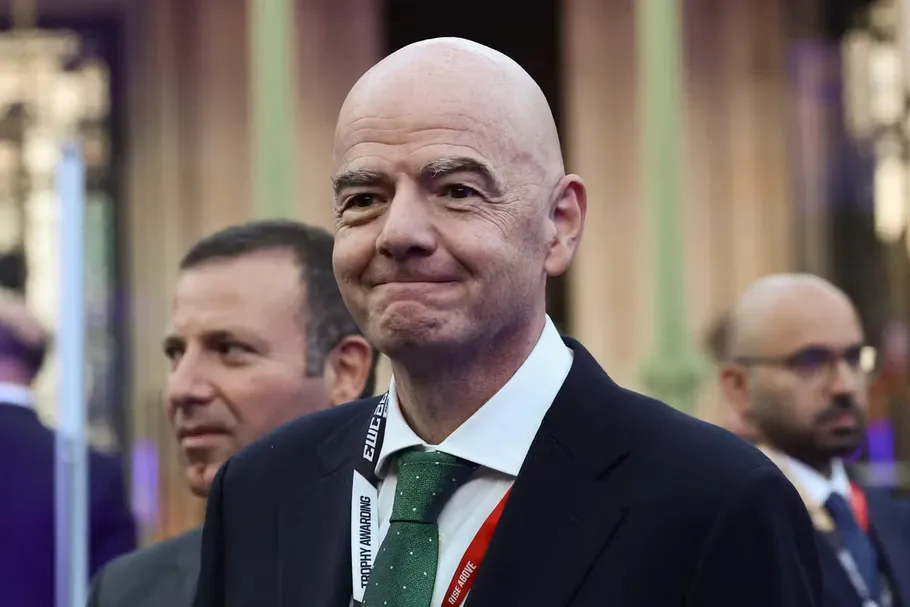
A group of prominent current and former players has intensified the scrutiny of Gianni Infantino, circulating a joint social-media message demanding change in FIFA’s leadership and in the way the game’s decision-making operates.
Mikaël Silvestre was among those to publish the intervention, with Lucy Bronze, Emmanuel Petit and David James also reported to have amplified it. Their complaint is not confined to one commercial dispute: it argues that players and supporters have been repeatedly sidelined while major choices are made at the top of the sport.
The timing matters. Infantino is already under pressure following the proposed sale of interests in a company intended to manage the World Cup, an idea that has prompted opposition from UEFA, Concacaf and the Asian Football Confederation. UEFA president Aleksander Ceferin has called for the FIFA president to leave office, although he has said he will not run against him in March.
Why Silvestre’s role gives the statement weight
This is more than a familiar exchange between federation executives. Silvestre serves on FIFA’s Players’ Voice Panel, a 16-person body created to contribute to anti-racism work. That does not make him a FIFA spokesperson, nor does it mean the panel itself has issued a position, but it gives his criticism an unusual institutional proximity.
The players’ message identifies the gap between consultation and representation as its central issue. It calls for a formal, meaningful role for players and fans in shaping football’s future rather than simply being asked to endorse decisions after they are made. That is a broader challenge than a demand to abandon the World Cup investment proposal, and it could outlast the immediate row around Infantino.
Bronze’s involvement is notable for a different reason. As an active international player, her support connects governance criticism to the dressing rooms and competitions that FIFA presents as the beneficiaries of its expansion. Petit and James add the reach of well-known former internationals, but the group’s influence will depend on whether more active players, unions or national-team captains move from sharing a statement to setting out specific demands.
Commercial plan remains the immediate flashpoint
The proposed World Cup structure has become the test case for concerns about transparency, influence and control. The opposing confederations have objected publicly, while Ceferin has argued that Infantino no longer has sufficient backing across the football community.
Yet the reports leave crucial questions unresolved. There is no detailed public account here of what stake would be offered, how much authority investors would receive, what safeguards would protect sporting decisions, or how any proceeds would be distributed. Without those details, the debate can easily become a referendum on personalities rather than an assessment of the plan itself.
That ambiguity also helps explain why the player statement is framed around process. A direct voice for players and fans would not automatically settle whether private capital should be involved in the World Cup. It could, however, establish who is entitled to challenge such proposals before they are advanced. For the campaign to become more than a symbolic protest, its organisers will need to define what representation they want: voting rights, independent consultation, disclosure obligations, or some combination of all three.
Support for Infantino has not disappeared
The emerging coalition should not be mistaken for a settled verdict across world football. Samuel Eto’o, president of the Cameroonian federation, has defended Infantino in a separate interview and portrayed the dispute as election-driven. Eto’o also argued that the FIFA Forward Enterprise project should return for consideration after a successful Infantino re-election, saying it could improve the position of African federations.
That response exposes the political divide at the heart of the dispute. Critics focus on accountability and the concentration of power around FIFA’s leadership. Supporters can point to the prospect of greater funding and influence for associations outside Europe’s traditional centre of gravity. The two cases are not necessarily mutually exclusive, but neither side has yet explained convincingly how wider financial redistribution and stronger democratic oversight would coexist.
Infantino spent the weekend at a youth tournament in the Dominican Republic, where relationships with Caribbean associations may carry particular importance ahead of the election. Concacaf’s opposition to the investor proposal demonstrates that regional leadership and individual member associations cannot simply be treated as one voting bloc.
Ronaldo footage is a side story, not evidence
Video of Cristiano Ronaldo briefly meeting Infantino at the Esports World Cup in Paris has added an eye-catching subplot. Social-media users interpreted Ronaldo’s expression as he walked away as displeasure, after Infantino referred to the forward’s pursuit of 1,000 career goals.
But the clip offers no reliable indication of Ronaldo’s view of FIFA’s leadership, and he has not been reported to have joined the players’ statement. Folding a fleeting public encounter into the governance dispute risks overstating its meaning.
The substantive development is the willingness of figures with links to FIFA programmes to voice criticism openly. Whether that becomes decisive will be determined less by viral posts than by the identity of any March challenger, the support among member associations, and whether FIFA answers the players’ call for a clearer role in how football is governed.